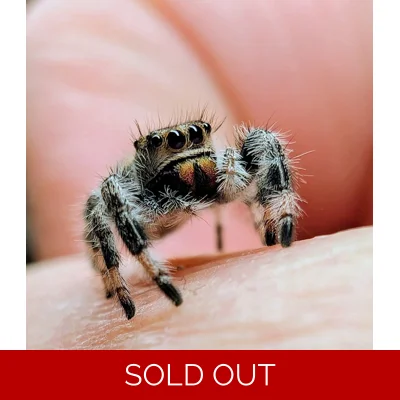
Apalachicola Jumping Spider Care Guide
Enclosure
-
A well-ventilated enclosure with more height than width is ideal.
-
Provide plenty of climbing surfaces such as twigs, bark, cork, and artificial or live plants.
-
Include a secure area near the top where your spider can build a hammock.
Temperature
-
Ideal range: 22–27°C (72–80°F).
-
Avoid temperatures below 18°C (64°F) for extended periods.
-
Keep away from direct sunlight and heat sources.
Humidity
-
Maintain moderate humidity of 50–70%.
-
Lightly mist one side of the enclosure every 2–3 days, allowing droplets for drinking while ensuring good ventilation to prevent mould.
Feeding
-
Feed appropriately sized live insects such as:
-
Fruit flies (for spiderlings)
-
Small crickets
-
Green or blue bottle flies
-
Small roaches
-
-
Prey should be no larger than the spider's abdomen.
-
Adults typically eat every 5–7 days, while juveniles may eat every 2–4 days.
Water
-
Most jumping spiders drink water droplets from misting.
-
Do not leave standing water dishes in small enclosures.
Molting
-
Your spider may refuse food and stay inside its hammock before molting.
-
Do not disturb or handle it during this time.
-
Wait 3–7 days after a successful molt before feeding or handling.
Handling
-
Jumping spiders are generally curious and can be gently handled.
-
Always handle them over a soft surface and never force interaction.
-
They may jump unexpectedly.
Cleaning
-
Remove uneaten prey within 24 hours.
-
Spot-clean waste as needed.
-
Replace substrate and deep-clean the enclosure when necessary without disturbing established hammocks unless essential.
Lifespan
-
Females generally live 1.5–2 years.
-
Males often live 1–1.5 years, though lifespan varies depending on care and species.